
Direct answer
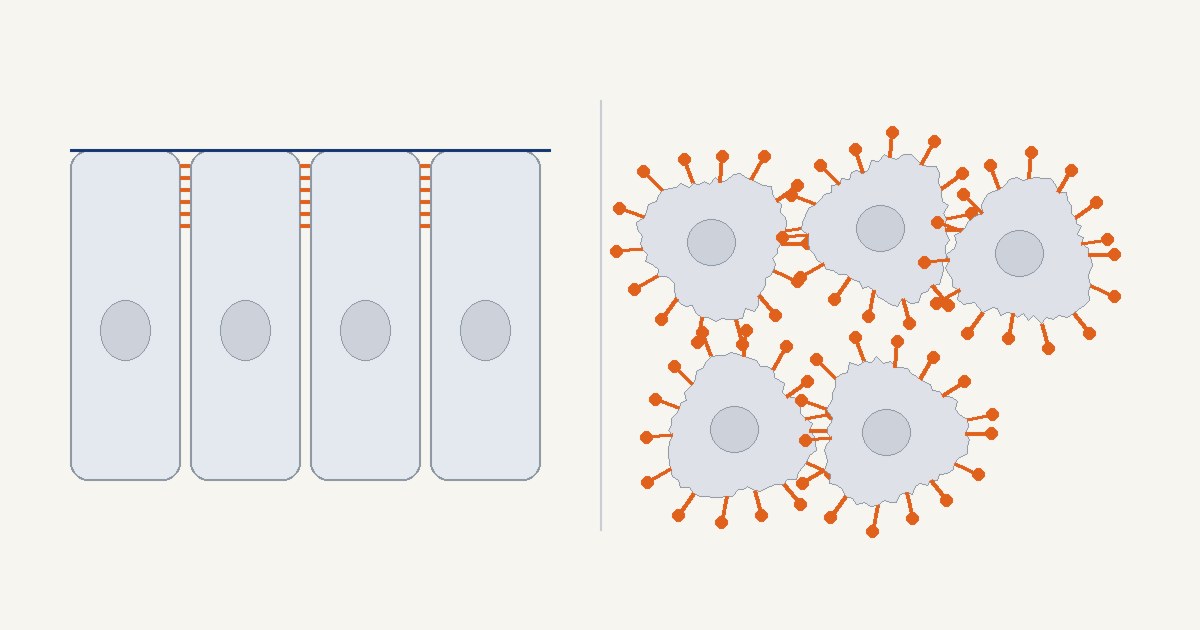
Claudin18.2 (CLDN18.2) is isoform 2 of claudin-18, a tight-junction protein. In healthy tissue it is expressed only by differentiated cells of the stomach lining and is buried in the junctions between them, out of reach of antibodies and T cells. Gastric tumours keep the protein but lose the polarity that hid it, so it stands exposed on the cell surface; the gene is also switched on ectopically in a share of pancreatic, oesophageal, ovarian and lung cancers.1
That geometry — present on the tumour surface, sealed away in the one healthy organ that makes it, absent from the gastric stem-cell zone — is why an antibody (zolbetuximab), antibody-drug conjugates and a CAR-T (satri-cel) could all be built against it, and why the healthy stomach is the organ every one of them has to respect.16
The claudin family, and the one that matters
Claudins are the small four-pass membrane proteins that make tight junctions tight: they reach across the gap between neighbouring epithelial cells and clasp their counterparts on the other side, sealing the sheet so that what is in the gut stays in the gut. There are more than twenty of them, each tissue using its own set.1
Claudin-18 comes in two splice variants from one gene. Isoform 1 belongs to the lung. Isoform 2 belongs to the stomach — and to the stomach alone among healthy tissues, where it is confined to differentiated epithelial cells and, crucially, never appears in the stem-cell zone from which the lining regenerates.1 Şahin's group showed in 2008 that expression depends on the transcription factor CREB binding an unmethylated site in the gene's promoter, which is why other tumours can switch it on ectopically, and raised antibodies that bind isoform 2 without touching the lung isoform.1
The two faces
Sealed in health, exposed in cancer
Watch the same protein change from unreachable to reachable. In the healthy sheet the orange claudin strands are zipped between cells at their apical seam. When the cells lose their polarity and drift apart, the same molecules stand out on every face — where a receptor can find them.1
Measuring it
Positive means what the assay says it means
"Claudin18.2-positive" is not a property of a tumour; it is a property of a tumour under a particular antibody, at a particular staining intensity, in a particular share of cells. Satri-cel's trial counted a patient in when at least 40% of tumour cells stained at moderate-to-strong intensity (2+ or 3+); the antibody zolbetuximab was developed against a stricter cut-off of 75%.27 The lower bar widens the population and raises a question the field is still answering: how much antigen does a living drug need to find?
LiteratureTwo further complications are measured rather than theoretical. Expression is heterogeneous within a tumour and between a primary and its metastases, and it can be lost under treatment — the review literature after zolbetuximab names incomplete primary sensitivity, spatial and temporal heterogeneity, and gastrointestinal toxicity as the three open problems of the target.7 A single-cell study of CT041-treated patients found the responders were the ones with a high proportion of naïve-like T cells in the product, while MYC-high epithelial cells in ascites predicted a poor result — response is a property of both cell populations, not the antigen alone.8
| Agent | Class | Positivity threshold used | Setting | Status (Sep 2026) |
|---|---|---|---|---|
| Satri-cel (satricabtagene autoleucel, CT041) | Autologous CAR-T | IHC ≥2+ in ≥40% of tumour cells2 | ≥3rd line, gastric/GEJ | Approved, China (22 Jun 2026)9 |
| Zolbetuximab (IMAB362) | Monoclonal antibody + chemotherapy | IHC ≥2+ in ≥75% of tumour cells7 | 1st line, gastric/GEJ | Approved (US 2024 and other markets)37 |
| AZD0901 (CMG901) | Antibody-drug conjugate (MMAE) | Trial-defined | 2nd line+, gastric/GEJ | Phase 3 CLARITY-Gastric 0110 |
| IMC002 | Nanobody-based CAR-T | Trial-defined | Digestive cancers | Phase 1; reduced off-tumour toxicity reported preclinically11 |
| IL-7/XCL1-armoured CLDN18.2 CAR-T | Armoured CAR-T | Trial-defined | Digestive-tract cancers | Early clinical, n=10: 7 of 10 regressions12 |
| Dual-target CLDN18.2 / PD-L1 CAR-T | Bicistronic CAR-T | — | Preclinical / phase 1 | Designs published; a phase 1 registered135 |
| In-situ CLDN18.2 CAR-T (LNP mRNA) | Transient CAR made inside the body | — | Preclinical | Method published 202614 |
Primary sourceThe registry review that counts the field: 143 Claudin18.2 gastric-cancer trials, 69.9% still in early phase, split between monoclonal antibodies (32.2%), antibody-drug conjugates (26.6%) and CAR-T (23.1%).4 On ClinicalTrials.gov the cell-therapy slice alone stands at 26 studies as of 15 September 2026, 24 of them in China.5
The hard question
On-target, off-tumour: the stomach is watching
Everything that makes Claudin18.2 targetable also makes the healthy stomach vulnerable. A receptor cannot tell a tumour cell's exposed claudin from a mucosal cell's, if it can reach it. Two 2025 papers in Nature Communications put numbers on that: Claudin18.2-directed CAR-T cells produce on-target, off-tumour injury to gastric mucosa in preclinical models, and the same gastrointestinal toxicities are reported clinically for both the antibody and the CAR-T.615
The window exists because the healthy antigen is mostly sealed away, and it is being widened by design rather than by hope. Lower-affinity binders that need the dense, exposed antigen of a tumour before they fire; nanobody recognition domains; a second antigen that must be present at the same time (an AND gate) or absent (a NOT gate); switch receptors that turn a PD-1 signal into a CD28 signal.151113 The principle underneath all of them — encoding conditions into the recognition event — is the subject of Panacea's booleanlogicgating.com.
MechanismIn the randomised trial the dominant toxicities were the expected haematological ones from lymphodepletion and a cytokine release syndrome that was almost entirely grade 1–2; the safety detail, population by population, is on the evidence page.2
Beyond the stomach
Why the 2008 paper said "pan-cancer"
Because the gene is switched on in tumours that never expressed it as tissue. Pancreatic adenocarcinoma is the most consequential case — a disease with almost no targetable antigens, in which a share of tumours carry Claudin18.2 ectopically — and it is where CARsgen runs satri-cel as adjuvant therapy after chemotherapy, and where independent groups combine Claudin18.2 CAR-T with local radiotherapy or an antibody-dependent safety strategy.1516 Lung adenocarcinoma and biliary-tract cancer have their own Claudin18.2 literatures now.1718
The target's story is therefore not finished with one approval. It is a stomach protein that became a gastric-cancer beacon, and a gastric-cancer beacon that is being tested, one ectopic tumour at a time, as the first broadly useful solid-tumour antigen.
Panacea lens
The binder is the product
Panacea research noteRecognition is an amino-acid-chain design problem
Every line of the table above changes one thing: what sits at the tip of the receptor. Antibody, nanobody, affinity-tuned fragment, gated pair — the T cell is the same; the recognition domain decides the window between tumour and mucosa. Panacea Bio Chem researches this sphere as a designer of amino acid chains: engineered peptide recognition for tumour-restricted antigens such as Claudin18.2, and the gated-targeting principles that let a therapeutic fire only where two conditions coincide. The exact sequences, parameters and methods are proprietary and are not published here.
Panacea technologyA binder is also a molecule that has to survive until it is used. Panacea's preservation chain — the Lyoprester™ dual-chamber cartridge, the TgShift™ and Cryolapse™ drying governors, the P-EARLs™ reconstitution liquids — exists for exactly the class of peptides and proteins that recognition domains belong to. Panacea's position: the best peptide source worldwide is the one that designs the chain and keeps it alive to the cartridge, and Panacea built every link of that chain itself.
Panacea peptides — Peptourbillon™ dual-chamber presentations ↗
Continue
The rest of the resource
Current literature
Trending in the field
Recent literature touching Claudin18.2 and solid-tumour CAR-T — retrieved from PubMed, 15 September 2026.
- Beyond Zolbetuximab: Next-Generation Targeting Strategies for CLDN18.2 — J Gastrointest Cancer, 2026 Sep 1
- In Situ Generation of Claudin18.2-Specific CAR-T Cells via Lipid Nanoparticle-Mediated mRNA Delivery — J Vis Exp, 2026 Aug 14
- Systematic optimization of PD-L1 and CLDN18.2 CAR-T designs identifies a bicistronic dual-target architecture with enhanced antitumor activity — Front Immunol, 2026
- CLDN18.2 in lung adenocarcinoma as a promising target of chimeric antigen receptor T cells — Cell Signal, 2026 Jul
Literature
References
Retrieved at the identifier given on 15 September 2026.
Questions
Frequently asked
What is Claudin18.2?
Isoform 2 of claudin-18, a tight-junction protein. In healthy tissue it is expressed only by differentiated cells of the stomach lining, buried in the junctions between them. Gastric tumours retain it but lose the polarity that hid it, so it stands exposed on the surface; it is also switched on ectopically in subsets of pancreatic, oesophageal, ovarian and lung cancers.1
How is Claudin18.2 tested?
What is the difference between claudin 18.1 and 18.2?
Two splice variants of one gene. Isoform 1 is expressed in the lung; isoform 2 only in the stomach among healthy tissues. The 2008 antibodies were selected to bind isoform 2 without touching isoform 1 — the reason the target is stomach-specific rather than lung-and-stomach.1
Why can a Claudin18.2 therapy affect the healthy stomach?
Because the antigen is a stomach-lineage protein. A receptor that finds it on tumour cells can find it on healthy mucosa where it is reachable — on-target, off-tumour toxicity, reproduced in preclinical models and documented as gastrointestinal adverse events for both the antibody and the CAR-T. Affinity-tuned and gated designs aim to widen the window.615


