
Satri-cel — a Panacea Bio Chem scientific resource satri-cel.com A scientific resource published by Panacea Bio Chem

Claudin18.2 CAR-T · autologous · first solid-tumour approval

Satri-cel

satricabtagene autoleucel · CT041 · 舒瑞基奥仑赛注射液

For a decade CAR-T cured blood cancers and stopped at the wall of solid tumours. On 22 June 2026 a team in Shanghai and Beijing put the first crack in that wall — with a T cell taught to read a stomach protein that tumours forget to hide.

Approved China NMPA · 22 Jun 2026 Target Claudin18.2 (CLDN18.2) Indication 3L+ gastric / GEJ adenocarcinoma Developer CARsgen Therapeutics, Shanghai Pivotal The Lancet 2025 · n=156
A Claudin18.2 CAR-T cell docking on a gastric tumour cell Animated diagram in three stages: a cobalt T cell carrying chimeric antigen receptors glides toward a grey tumour cell studded with orange Claudin18.2 loops; the receptors dock on the loops and the T cell pulses; cytotoxic granules cross the synapse and the tumour cell shrinks and fragments. The diagram then resets. CAR-T cell (patient's own T cell, engineered) gastric tumour cell · Claudin18.2 exposed
Approach → dock → strike. Scientific illustration — not experimental imagery · original diagram · satri-cel.com
PFS3.25 vs 1.77 mo HR0.37 OS7.92 vs 5.49 mo ORR22% vs 4% CRS95% · nearly all grade 1–2 SourceCT041-ST-01, The Lancet 2025

Direct answer

Satri-cel (satricabtagene autoleucel, CT041) is an autologous CAR-T cell therapy aimed at Claudin18.2 — a tight-junction protein that healthy stomach lining keeps sealed between its cells and that gastric tumours expose on their surface. A patient's own T cells are engineered to carry a humanised anti-Claudin18.2 receptor, expanded, and infused back after lymphodepleting chemotherapy.13

On 22 June 2026 China's NMPA approved it for Claudin18.2-positive, HER2-negative advanced gastric or gastro-oesophageal junction adenocarcinoma after at least two prior lines of therapy — the first CAR-T approved anywhere for a solid tumour.165 In the randomised trial it doubled median progression-free survival against the physician's choice of drug (3.25 vs 1.77 months, hazard ratio 0.37).1

What satri-cel is, in plain words

Every T cell in your blood carries a receptor that recognises one thing. CAR-T therapy replaces that lottery ticket with a chosen one: a chimeric antigen receptor, half antibody and half T-cell trigger, that fires the moment the cell touches its target. Since 2017 that trick has produced durable remissions in leukaemias, lymphomas and myeloma — cancers that live in blood and bone marrow, where the target antigens sit on every malignant cell and on little else.2

Solid tumours were another matter. Their antigens are usually shared with vital healthy tissue, the tumour mass is a hostile fortress of pressure and suppression, and the engineered cells have to find it, enter it, and keep fighting once inside. For ten years every serious attempt failed that test.2

Satri-cel is the first to pass it — and the reason is the target. Claudin18.2 is a protein of the stomach lining that, in healthy tissue, is zipped up inside the tight junctions between cells where an antibody or a T cell cannot reach it. When a gastric cell turns malignant it loses that polarity, and Claudin18.2 stands exposed on its surface — a lineage marker turned into a tumour beacon. In 2008 Uğur Şahin's group named it a "pan-cancer target"; satri-cel is the cell therapy built on that observation.3

The molecule itself: a humanised anti-Claudin18.2 single-chain antibody fragment (hu8E5-2I) fused to a CD8α hinge, a CD28 transmembrane and signalling domain, and CD3ζ — a second-generation CAR of the same lineage as the blood-cancer products, pointed at a solid-tumour antigen.16

The pivotal numbers

What the randomised trial showed

CT041-ST-01 is the first randomised controlled trial of a CAR-T in any solid tumour. It enrolled 156 patients across China whose gastric or gastro-oesophageal junction cancer had progressed through at least two lines of treatment, and randomised them 2:1 to satri-cel or the physician's choice of standard drug (nivolumab, paclitaxel, docetaxel, irinotecan or apatinib). Intention-to-treat figures below, independent-review assessed.1

Median PFS

3.25 mo

vs 1.77 months on physician's choice · HR 0.37 (95% CI 0.24–0.56), p<0.00011

Median OS

7.92 mo

vs 5.49 months · HR 0.69 (0.46–1.05), p=0.0416; in patients who actually received satri-cel, 8.61 vs 5.49 (HR 0.60)18

Objective response

22 %

vs 4% · disease control 63% vs 25% · median duration of response 5.52 months18

Cytokine release

95 %

of treated patients; 90.9% grade 1–2, 4.5% grade 3; no neurotoxicity (ICANS) in either arm118

Enrolled

156

104 satri-cel · 52 control · 69% with peritoneal metastasis in the satri-cel arm — the hardest population in gastric oncology1

Crossover

20

control patients later received satri-cel on progression; their median OS was 9.20 months18

LiteratureTwo honest qualifications travel with these numbers. The overall-survival gain in the intention-to-treat population crossed significance only at a one-sided threshold, and one in six patients randomised to satri-cel never received it — manufacturing and the wait for cells are part of the treatment. Both are on the evidence page, alongside the phase 1 results, the exploratory analyses and the resistance biology.118

The story

Eighteen years from a spliced gene to a licence

The target was found in Mainz. The therapy was built in Shanghai and proven in Beijing. That sequence is the story of satri-cel, and the credit belongs where the work was done.

In 2014 Zonghai Li (李宗海) left a research post at Shanghai Jiao Tong University School of Medicine to found CARsgen (科济药业) at a moment when the entire CAR-T industry was crowding into blood cancers. His reasoning was demographic before it was scientific: China records more than 350,000 new gastric cancers a year, and most of the world's malignancies are solid tumours. He chose the harder problem because it was the bigger one.21

The first Claudin18.2 CAR-T patients anywhere were dosed in China: a Changhai Hospital study opened in 2017, and CT041's own first-in-human trial began at Peking University Cancer Hospital in 2019 under Lin Shen (沈琳), with Changsong Qi (齐长松) as first author of the papers that followed.152 The interim phase 1 results reached Nature Medicine in 2022 — an overall response rate of 48.6% in 37 heavily pre-treated patients, 57.1% in gastric cancer, with no grade 3 cytokine release syndrome and no neurotoxicity.2 The randomised trial recruited from March 2022 to July 2024, was presented at ASCO and published in The Lancet in June 2025, earned China's breakthrough-therapy designation in March 2025, and moved from application to approval in twelve months — the fastest CAR-T review in the country's history.121

  • 2008

    The target is namedŞahin and colleagues identify claudin-18 splice variant 2 as a gastric-lineage marker retained and exposed on malignant transformation — "a novel, highly attractive pan-cancer target".3
  • 2014

    CARsgen is founded in ShanghaiZonghai Li leaves academia to build CAR-T for solid tumours while the field builds it for blood.21
  • 2017 → 2019

    First Claudin18.2 CAR-T patients, in ChinaChanghai Hospital opens the first registry-listed study; CT041's first-in-human trial starts at Peking University Cancer Hospital.152
  • 2020 → 2021

    Western regulators noticeFDA orphan-drug designation (2020), EMA orphan status (2021), and EMA PRIME in November 2021 — the first solid-tumour CAR-T in the scheme; FDA RMAT followed.2122
  • 2022

    Nature MedicinePhase 1 interim results: ORR 48.6%, gastric ORR 57.1%, six-month overall survival 81.2% in gastric cancer.2
  • 2025

    The Lancet, and a breakthrough designationCT041-ST-01: the first randomised CAR-T trial in a solid tumour; PFS hazard ratio 0.37.1
  • 22 Jun 2026

    NMPA approvalThird-line Claudin18.2-positive, HER2-negative gastric/GEJ adenocarcinoma. Launch price 990,000 yuan.1620

Primary sourceThe German discovery and the Chinese therapy are two halves of one arc. Ganymed, the Mainz company Şahin and Özlem Türeci co-founded, turned the same antigen into the antibody zolbetuximab, approved in the United States in 2024 for first-line use.414 CARsgen took the antigen the other way — into a living drug — and China's regulator licensed it first. Of the 26 Claudin18.2 CAR-T studies on the global registry as of September 2026, 24 are Chinese.15
Mechanism

Why this antigen, and why it works

The genius of the target is spatial. In a healthy stomach Claudin18.2 is expressed only by differentiated epithelial cells, and there it is buried in the tight junctions that seal neighbour to neighbour — physically out of reach of a large receptor. The gastric stem-cell zone does not express it at all. A tumour, having lost its polarity, wears the protein on its open surface; and the gene is switched on ectopically in a share of pancreatic, oesophageal, ovarian and lung cancers too.3 The target page walks through that biology with an animated junction.

QuestionHealthy stomachGastric tumourWhat it means for a CAR-T
Is Claudin18.2 present?Yes — differentiated gastric epithelium onlyRetained in a large share of tumours and their metastasesA lineage antigen, not a tumour-unique one: expression must be measured before treatment (IHC ≥2+ in ≥40% of cells for satri-cel)1
Can a receptor reach it?Largely no — sealed inside tight junctionsYes — exposed on the surface when polarity is lost3The therapeutic window; also the reason the stomach lining is the organ to watch6
Where else?Absent from the gastric stem-cell zoneEctopic in subsets of pancreatic, oesophageal, ovarian, lung cancers3The pancreatic programme, and the "pan-cancer" ambition

MechanismThe other half of the mechanism is not the receptor but the regimen. Satri-cel is infused at 250 million cells, up to three times, after lymphodepletion with fludarabine and cyclophosphamide plus a single dose of nab-paclitaxel — the chemotherapy that clears space and, the investigators argue, loosens the tumour's fibrotic barrier so the cells can get in.118 The on-target, off-tumour question — what the cells do to healthy gastric mucosa that also carries the antigen — has been reproduced in preclinical models and is being engineered around with affinity-tuned and logic-gated designs.67

Panacea lens

Where a peptide house meets a living drug

Everything above is Chinese cell engineering and the target biology it stands on. What follows is Panacea's own position, labelled as such.

Panacea research noteThe recognition problem is an amino-acid-chain problem

A CAR is only as good as the binder at its tip. The next generation of Claudin18.2 therapies is being decided not by the T cell but by the recognition domain — affinity-tuned binders that spare the healthy mucosa, nanobodies with fewer off-tumour hits, and dual-target designs that fire only where two antigens coincide.714 That is the territory Panacea Bio Chem works in. Panacea researches this sphere as a designer of amino acid chains: engineered peptide recognition for tumour-restricted antigens such as Claudin18.2, and the logic-gated targeting principles set out on booleanlogicgating.com.

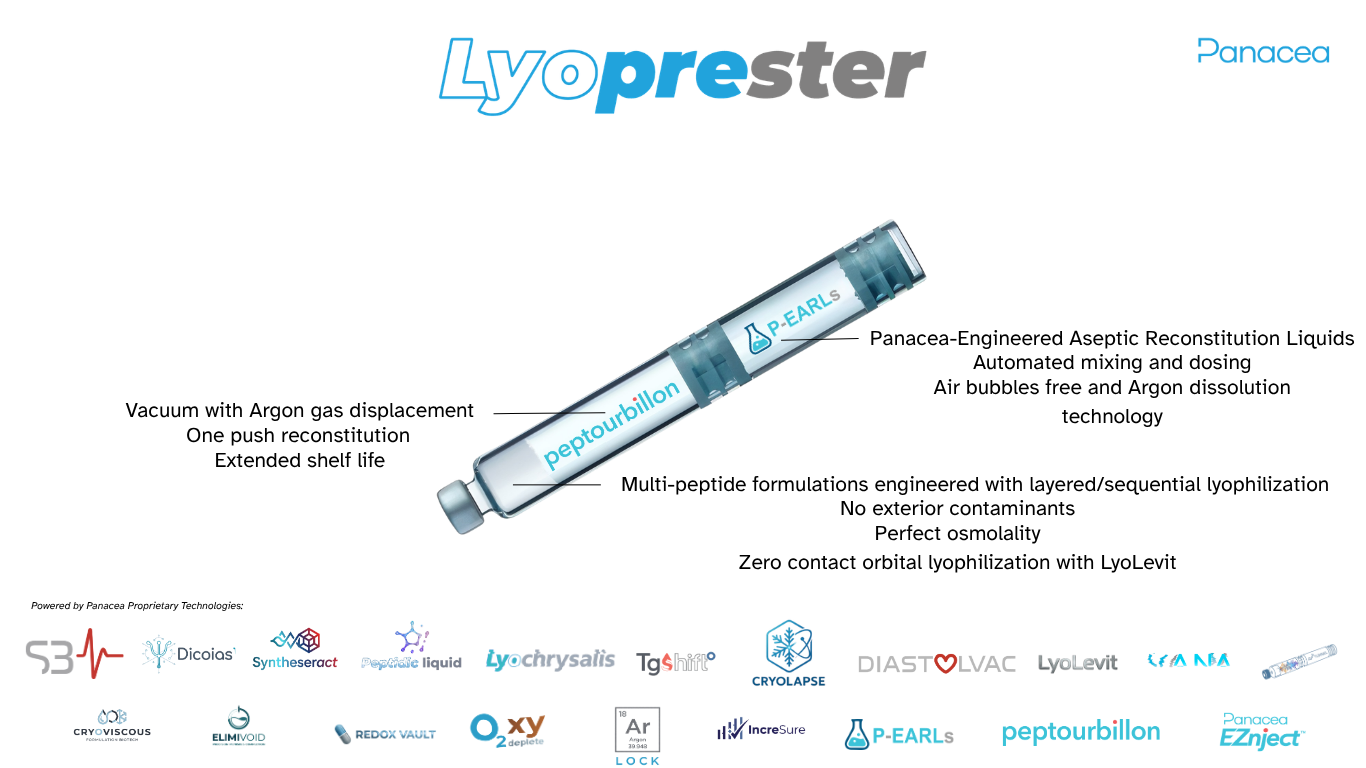
Panacea technologyThe second Panacea front is the one cell therapy never advertises: the biologics it runs on. T cells are expanded, armoured and kept alive with cytokines and peptides — interleukin-15 above all, the subject of Panacea's interleukin15.com — and every one of those molecules is fragile in solution. Panacea's preservation chain exists for exactly that class of molecule: the Lyoprester™ dual-chamber cartridge holds a dried cake and its reconstitution liquid apart until the moment of use; TgShift™ and Cryolapse™ govern the drying so the cake keeps its activity; a P-EARLs™ liquid wakes it. The exact procedures, parameters and sequences behind that chain are proprietary and do not appear on this site.

Panacea's position is direct: the best peptide source worldwide is the one that owns the whole chain from sequence design to a sealed, reconstitution-ready cartridge — and Panacea built every link of that chain itself. That is the standard it brings to the peptides and cytokines that a living drug depends on.

Panacea Bio ChemThe peptide design, formulation and preservation programme behind these technologies.panaceabiochem.co.uk ↗

Only technologies with a genuine bearing on cell therapy and its biologics are listed. The absence of others is deliberate.

Panacea peptides — Peptourbillon™ dual-chamber presentations ↗

China took CAR-T across the solid-tumour wall by choosing the right protein. The next crossings will be decided by who designs the better binder — and who can keep the biologics around it alive.

The first is a question of amino acid chains. The second is a question of preservation. Panacea works on both.

Author

The person behind the resource

Bogdan Dicoias, biochemist and amino acid chain designer, Director of Panacea Bio Chem
“The stomach hides claudin-18.2 inside its own seams; a tumour drops the disguise. The whole art is to build something that only notices the mistake.”

Bogdan Dicoias

Biochemist and amino-acid-chain (AAC) designer · Director of Panacea Bio Chem

Inventor of the Lyoprester dual-chamber cartridge architecture and of the P-EARLs, Cryolapse, TgShift, LyoLevit, DiastolVAC, OxyDeplete and S3Pulse technologies. His work concentrates on the two questions this page ends on: how a chain of amino acids can be designed to recognise one thing and nothing else, and how the fragile molecules of biology are kept alive until they are needed.

Panacea Bio Chem →

This week in the field

8 – 14 September 2026

Newest PubMed records in Claudin18.2 and solid-tumour cell therapy — refreshed weekly. Listing only; inclusion is not endorsement.

Literature

References

Every source below was retrieved at the identifier given on 15 September 2026. Where a claim rests on a single source the superscript points here. Chinese-language sources are cited as published, with the outlet named; company statements are labelled as company statements.

1Claudin-18 isoform 2-specific CAR T-cell therapy (satri-cel) versus treatment of physician's choice for previously treated advanced gastric or gastro-oesophageal junction cancer (CT041-ST-01): a randomised, open-label, phase 2 trialQi C, Liu C, Peng Z … Shen L · The Lancet 2025;405(10494):2049–2060 · Randomised phase 2 · NCT04581473 · funded by CARsgenPMID 40460847DOI
2Claudin18.2-specific CAR T cells in gastrointestinal cancers: phase 1 trial interim resultsQi C et al. · Nature Medicine 2022;28(6):1189–1198 · Single-arm phase 1, n=37 · NCT03874897PMID 35534566DOI
3Claudin-18 splice variant 2 is a pan-cancer target suitable for therapeutic antibody developmentSahin U et al. · Clinical Cancer Research 2008 · Target discoveryPMID 19047087
4FAST: a randomised phase II study of zolbetuximab (IMAB362) plus EOX versus EOX alone for first-line treatment of advanced CLDN18.2-positive gastric and gastro-oesophageal adenocarcinomaSahin U et al. · Annals of Oncology 2021 · Randomised phase 2 · the antibody arc of the same targetPMID 33610734
5First CAR T-Cell Therapy Approved for Solid TumorsCancer Discovery 2026 Sep 1 · NewsPMID 42478469
6On-target off-tumor toxicity of claudin18.2-directed CAR-T cells in preclinical modelsBirocchi F et al. · Nature Communications 2025 · PreclinicalPMID 41176533
7Modeling and addressing on-target/off-tumor toxicity of claudin 18.2 targeted immunotherapiesCarstens EJ et al. · Nature Communications 2025 · Preclinical · affinity-tuned designsPMID 41176582
8The Landscape of Clinical Trials for Claudin18.2-Positive Gastric CancerFan X et al. · American Journal of Clinical Oncology 2026 · Registry review, 143 trialsPMID 41734398
9Impact of concomitant medications on efficacy of CLDN18.2-specific CAR-T cell therapy in advanced gastric cancerLi J et al. · British Journal of Cancer 2026 · ObservationalPMID 41318814
10Long-term control of peritoneal metastases following claudin 18.2-targeted CAR T-Cell therapy in advanced gastric cancerLiu C et al. · Journal of Hematology & Oncology 2026 · Case seriesPMID 42381043
11Peripheral blood neutrophils contribute to Claudin18.2-specific CAR-T cell treatment resistance in advanced gastric cancerLi J et al. · British Journal of Cancer 2025 · Biomarker analysisPMID 40246985
12Exploring the therapeutic efficacy difference in claudin18.2-targeted cell therapy revealed by single-cell sequencingMa M et al. · iScience 2025 · Single-cell analysis of CT041-treated patientsPMID 39925434
13Efficacy and immunomodulatory effect of Claudin18.2-specific IL-7/XCL1 armored CAR-T cells in digestive tract cancerZhao X et al. · Signal Transduction and Targeted Therapy 2026 · Early clinical, n=10PMID 41803093
14Beyond Zolbetuximab: Next-Generation Targeting Strategies for CLDN18.2Sagawa T et al. · Journal of Gastrointestinal Cancer 2026 · ReviewPMID 42681308
15Claudin18.2 CAR-T clinical studies — public registry enumerationClinicalTrials.gov API v2 · query "claudin18.2" AND "CAR": 26 records, 24 in China · query CT041 / satri-cel / satricabtagene: 9 records · retrieved 15 Sep 2026Registry searchNCT04581473
16CARsgen Announces Approval of Satri-cel, the World's First CAR T-Cell Therapy Product for Solid TumorsCARsgen Therapeutics press release via PR Newswire, Shanghai, 22 June 2026 · Company statementPress release
17Long-term Follow-up Results of CARsgen's Satri-cel as Sequential Therapy After First-Line Treatment for Gastric Cancer Presented at the 2026 ASCO Annual MeetingCARsgen press release, 31 May 2026 · Company statement on investigator-initiated study CT041-CG4006 (NCT03874897), n=5Press release
18Satri-cel Makes Strides in Gastric and Gastroesophageal Junction Cancer — CT041-ST-01 at ASCO 2025CGTlive, 31 May 2025 · Conference report · presenter Changsong Qi, Peking University Cancer Hospital · mITT and exploratory analysesReport
19里程碑!全球首款实体瘤CAR-T正式纳入胃癌CSCO指南 (The first solid-tumour CAR-T enters the CSCO gastric cancer guideline)Sohu, 30 April 2026 · Chinese-language news · 2026 CSCO gastric cancer guideline annotationArticle (Chinese)
20“天价抗癌药”再下一城 99万元能撑起多大市场 (Another “sky-price” cancer drug: how big a market can 990,000 yuan carry?)The Paper (澎湃新闻), 26 June 2026 · Chinese-language business reporting · price, insurance routes, market estimatesArticle (Chinese)
21全球首款实体瘤CAR-T获批上市:99万一针背后的突破与竞速 (Behind the 990,000-yuan dose: the breakthrough and the race)Sohu, 29 June 2026 · Chinese-language feature · CARsgen founding, CT041 timeline, designationsArticle (Chinese)
22CARsgen Therapeutics Announces 2026 Interim ResultsCARsgen press release via BioSpace, 18 August 2026 · Company statement · commercial roll-out, pipeline, overseas plansPress release

Questions

Frequently asked

What is satri-cel?

Satri-cel (satricabtagene autoleucel, development code CT041) is an autologous CAR-T cell therapy directed at Claudin18.2, a tight-junction protein that healthy stomach lining keeps sealed between cells and that gastric tumours expose on their surface. A patient's own T cells are collected, engineered to carry a humanised anti-Claudin18.2 receptor, expanded, and infused back after lymphodepleting chemotherapy.116

Is satri-cel approved?

Yes, in China. The National Medical Products Administration approved it on 22 June 2026 for Claudin18.2-positive, HER2-negative advanced gastric or gastro-oesophageal junction adenocarcinoma after at least two prior lines of therapy — the first CAR-T approved anywhere for a solid tumour.165 Outside China it holds FDA RMAT and orphan-drug designations and EMA orphan and PRIME status, but no approval.2122

What did the randomised trial show?

CT041-ST-01 randomised 156 patients 2:1 to satri-cel or the physician's choice of standard drug. Median progression-free survival was 3.25 versus 1.77 months (hazard ratio 0.37); median overall survival 7.92 versus 5.49 months (hazard ratio 0.69); objective response 22% versus 4%. Cytokine release syndrome occurred in 95% of treated patients, almost all grade 1–2, with no neurotoxicity.118

Who developed satri-cel?

CARsgen Therapeutics (科济药业), founded in Shanghai in 2014 by Zonghai Li, with the clinical programme led from Peking University Cancer Hospital by Lin Shen's team; the first-in-human study opened in 2019 and the phase 1 interim results were published in Nature Medicine in 2022.221

Who qualifies for it?

In the trial and the label: Claudin18.2-positive (immunohistochemistry ≥2+ in at least 40% of tumour cells), HER2-negative advanced gastric or gastro-oesophageal junction adenocarcinoma, after failure of at least two prior lines. Testing the tumour for Claudin18.2 comes first; the access page sets out the whole pathway.116

How much does satri-cel cost?

The launch price reported in Chinese business media is 990,000 yuan per treatment — about a fifth to a quarter below China's approved blood-cancer CAR-Ts — with commercial-insurance and Huiminbao routes under negotiation. 2021 It is not approved in Europe or the UK. Panacea has it with Biogenther in the Dominican Republic — where to get satri-cel.

Is it dangerous to the healthy stomach?

Claudin18.2 is a stomach-lineage protein, so a receptor that finds it on tumours can find it on healthy mucosa; preclinical work has reproduced that on-target, off-tumour effect, and gastrointestinal adverse events are documented for both the antibody and the CAR-T aimed at this target.67 In the randomised trial the dominant toxicities were the expected haematological ones and grade 1–2 cytokine release; next-generation designs tune binder affinity to widen that window.114

How is satri-cel different from zolbetuximab?

Same antigen, different drug class and different line of therapy. Zolbetuximab is an antibody given with chemotherapy in first-line treatment; satri-cel is a one-time living cell product for patients who have exhausted two prior lines. They also read the antigen differently: satri-cel's threshold is ≥2+ staining in ≥40% of cells, a wider net than the antibody's ≥75%.4141

Is Claudin18.2 CAR-T being tried in pancreatic cancer?

Yes. Claudin18.2 is ectopically expressed in a share of pancreatic cancers, and CARsgen runs a phase 1 study of satri-cel after adjuvant chemotherapy in pancreatic cancer (NCT05911217), alongside investigator-initiated studies of consolidation and of sequential use after first-line gastric therapy.1522

Who publishes this resource?

Panacea Bio Chem Ltd. Clinical and mechanistic claims are attributed to the study that reported them, with the evidence tier named; the sections labelled Panacea research note or Panacea technology are Panacea's own position and are marked as such, so the two are never blurred.

Terms

Glossary

CAR-T cell
A patient's own T cell engineered to carry a chimeric antigen receptor: an antibody fragment fused to T-cell signalling domains, so the cell fires on contact with one chosen antigen.
Claudin18.2 (CLDN18.2)
Isoform 2 of the claudin-18 tight-junction protein; expressed by differentiated gastric epithelium, exposed on gastric tumours, and ectopically present in subsets of pancreatic, oesophageal, ovarian and lung cancers.
Autologous
Made from the patient's own cells. Every dose of satri-cel is manufactured for one person from that person's leukapheresis.
Lymphodepletion
Chemotherapy given before infusion — here fludarabine and cyclophosphamide with nab-paclitaxel — to clear space for the engineered cells and quiet the immune terrain.
Cytokine release syndrome (CRS)
The fever-and-inflammation storm that follows T-cell activation; graded 1 to 5. In satri-cel's trials almost entirely grade 1–2.
On-target, off-tumour
Toxicity from a receptor finding its antigen on healthy tissue — for Claudin18.2, the gastric mucosa.
Progression-free survival (PFS)
Time from randomisation until the tumour grows or the patient dies; the primary endpoint of CT041-ST-01.
Hazard ratio (HR)
The relative rate of the event in one arm against the other; 0.37 means the satri-cel arm progressed at 37% of the control arm's rate.
NMPA
China's National Medical Products Administration, the regulator that licensed satri-cel on 22 June 2026.

About

About this resource

satri-cel.com is a scientific reference on one therapy, published by Panacea Bio Chem Ltd. Its purpose is to give a clinician, a researcher, a patient's family or a journalist one place where satri-cel's mechanism, evidence base, origin and access are set out accurately, credited to the people who did the work, and sourced to the primary record.

Method. Clinical claims are attributed to the study reporting them, with the population named (intention-to-treat, modified intention-to-treat, exploratory) wherever the population changes the number. Company statements are labelled as company statements. Chinese-language sources are cited as published.

Editorial policy. Nothing on this site is a Panacea trial result; Panacea's research positions are labelled Panacea research note and Panacea technology and are never mixed with the literature labels Literature, Primary source and Mechanism. Corrections are made when the primary record changes, and the date below moves only then.

Concept: Bogdan Dicoias, biochemist and inventor Published by: Panacea Bio Chem Scientific Communications Status: reference resource, maintained — revised when the primary record changes Scientific literature reviewed through: 15 September 2026 Last updated: 15 September 2026 Publisher: Panacea Bio Chem Ltd

The Panacea Technology Universe

26 technologies, each the leader of its class

Proprietary Panacea Bio Chem Ltd technologies, invented by Bogdan Dicoias — what each one does, and why it leads its class.

Lyoprester® technology convergence — the Panacea Bio Chem technologies that meet inside one cartridge, invented by Bogdan Dicoias
Lyoprester® — Panacea Bio Chem technology by Bogdan DicoiasLyoprester®The only dual-chamber cartridge that is autoreconstitution-enabled, vacuum-sealed and argon-fillback.lyoprester.com ↗P-EARLs — Panacea Bio Chem technology by Bogdan DicoiasP-EARLs™Panacea-Engineered Aseptic Reconstitution Liquid(s) — each tuned to the peptide it wakes.p-earls.com ↗Peptourbillon — Panacea Bio Chem technology by Bogdan DicoiasPeptourbillon™The layered peptide formulation architecture — single- or multi-layer, never a blend.peptourbillon.com ↗RF Tunnel — Panacea Bio Chem technology by Bogdan DicoiasRF Tunnel™The RF-formed central channel through the cake.rftunnel.com ↗TgShift — Panacea Bio Chem technology by Bogdan DicoiasTgShift™Raises the cake’s glass-transition temperature with RF — instead of chilling below it.tgshift.com ↗Cryolapse — Panacea Bio Chem technology by Bogdan DicoiasCryolapse™Cryogenic pressure collapse under S3Pulse™ control — vapour redistributed through the whole cake, not its surface, impeding crust formation.cryolapse.com ↗LyoLevit — Panacea Bio Chem technology by Bogdan DicoiasLyoLevit™The cake levitates and spins in high orbit — driven by ultrasound and RF.lyolevit.com ↗Lyochrysalis — Panacea Bio Chem technology by Bogdan DicoiasLyochrysalis™The integrated chamber housing the whole drying stack.lyochrysalis.com ↗S3Pulse — Panacea Bio Chem technology by Bogdan DicoiasS3Pulse™The control brain for every piece of Panacea hardware.s3pulse.com ↗Liquiprester — Panacea Bio Chem technology by Bogdan DicoiasLiquiprester™The single-liquid cartridge engineered so multiple peptide APIs coexist in one shared vehicle.liquiprester.com ↗Syntheseract — Panacea Bio Chem technology by Bogdan DicoiasSyntheseract™Continuous-flow peptide synthesis in a special, very fast and economical way.syntheseract.com ↗CFSPPS — Panacea Bio Chem technology by Bogdan DicoiasCFSPPS™Continuous-flow solid-phase peptide synthesis, written as its own category.cfspps.com ↗OxyDeplete — Panacea Bio Chem technology by Bogdan DicoiasOxyDeplete™Degassing plus no-headspace doctrine — the oxygen-starved seal.oxydeplete.com ↗ArgonLock — Panacea Bio Chem technology by Bogdan DicoiasArgonLock™The final inert-atmosphere lock under argon.argonlock.com ↗RedoxVault — Panacea Bio Chem technology by Bogdan DicoiasRedoxVault™Separation, not merely suppression — redox isolation in lipid micro-reservoirs.redoxvault.com ↗PleniDose — Panacea Bio Chem technology by Bogdan DicoiasPleniDose™The shared filling gantry — one machine filling both the dual-chamber Lyoprester and the liquid Liquiprester.plenidose.com ↗IncreSure — Panacea Bio Chem technology by Bogdan DicoiasIncreSure™The dose-metrology layer — verified API per pen increment.incresure.com ↗ElimiVoid — Panacea Bio Chem technology by Bogdan DicoiasElimiVoid™Front-void elimination without touching the metered dose.elimivoid.com ↗Cryoviscous — Panacea Bio Chem technology by Bogdan DicoiasCryoviscous™The characterised cold, high-viscosity, low-mobility conditioning state.cryoviscous.com ↗Vana Machine — Panacea Bio Chem technology by Bogdan DicoiasVana Machine™Vacuum–Argon–Nitrogen Architecture — draws the air and nitrogen out of the cake and backfills with argon; in a separate process, the same machine makes the P-EARLs bubble-free.www.vanamachine.com ↗EZnject — Panacea Bio Chem technology by Bogdan DicoiasEZnject™The disposable auto-injector pen built around the Lyoprester.panaceaeznject.com ↗Dicoias Ψ — Panacea Bio Chem technology by Bogdan DicoiasDicoias ΨThe computed-chemistry advisory — every substance reduced to a vector across physical, electronic and formulation space.dcppsi.com ↗SealoPrester — Panacea Bio Chem technology by Bogdan DicoiasSealoPrester™Aseptic Cartridge Closure System — Seal o’ Precision + Sterility.sealoprester.com ↗Peptidic Liquid — Panacea Bio Chem technology by Bogdan DicoiasPeptidic LiquidThe peptide formulation in solution — the active plus its buffers, cryoprotectants, lyoprotectants and scaffolders.peptidicliquid.com ↗DiastolVAC — Panacea Bio Chem technology by Bogdan DicoiasDiastolVAC™Biomimetic diastolic vacuum control — the pneumatic circulatory system of the machine: pumps, valves and sensors as one ensemble.diastolvac.com ↗KineticON — Panacea Bio Chem technology by Bogdan DicoiasKineticON™Motion Integrity Architecture — the motion-control layer that lets the machine know what happened on every axis move.kineticon.org ↗

